The 'Sound' in Sound Technology Japan, Inc.
Talking about Sound Technology Japan, Inc. (Suntec), a karaoke-data company that published two PlayStation games again.
My entire Suntec research arc started because, while reading about the history of karaoke and its surrounding culture, I stumbled upon BMB, and for some reason, I hallucinated a connection between that and 10101: "Will" The Starship (1997), the game I was just about to play. The connection seemed very much plausible due to matching timelines and Suntec's karaoke connection the Japanese Wikipedia suggested (Japanese Wikipedia, n.d.-b). The hypothesis was about Will, the battleship's name in the game, which I believed was named after BMB's karaoke machine/series, also named WILL. Unfortunately, I was wrong. No source checked here connects the ship's name to BMB hardware. The histories I consulted list no such product. I mainly read summaries, so it is technically possible that I just missed something, but my brain making up things is a more likely answer. Regardless, might as well look into what I found anyway.
In 1997, BMB was still 株式会社日光堂 (Nikkodo Co., Ltd.), which entered a capital and business alliance with 有線ブロードネットワークス (Usen Broad Networks) in October 2000 and changed its name to 株式会社ユーズ・ビーエムビーエンタテイメント (U's BMB Entertainment) in March 2001, became a consolidated subsidiary in January 2004, and renamed itself 株式会社BMB (BMB Co., Ltd.) in January 2005 (BMB, 2005). BMB International's retrospective English history table lists T8N (1978), NCD (1984), NKL (1985), CDI (1991), a CD Motion Picture Karaoke System (1994), BeMAX'S (1995), neon (1997), neon R2 and UGA (2004), UGA PLUS (2005) and UGA NEXT (2008), and no WILL (BMB International Corp., 2026). Well, this sucks. But maybe the Japanese history page is more informative, let's see: it lists the company's launches through 通信カラオケ「neon」, 「neonR2」 and 「UGA」, then the 2005 rename to 株式会社BMB. It contains no "WILL" or "ウィル" (BMB, 2005). Such tables show major product lines, so this is evidence of absence, not proof that no product of that name ever existed, right? Yeah, but at this point, I'm basically just coping. The only statement on Japanese Wikipedia (n.d.-a) about the title is 「タイトルの「10101」は二進法に由来する」(“The title ‘10101’ comes from the binary number system.”), and even that is unsourced.
Since we're talking about the audio side, I think it's best to continue some lines from our previous article. Mitsui Kazumasa (三井一正) was a musician who worked with Sound Technology Japan, Inc. from 1993 to 1997. His personal site has a page titled サンテック that describes it (Mitsui, n.d.-a):
(株)サンテックジャパン
SOUND TECHNOLOGY JAPAN,INC. は主に通信カラオケのデータ制作会社で、約10,000曲の制作実績がある。現在は音楽制作よりゲームソフトをメインに制作をしている。ゲームは監督と脚本を担当。
In English, the company was mainly a communications-karaoke data production company with a production record of about 10,000 songs, now making game software more than music, and he handled direction and script for the games.
His career profile lists "1993~97 (株)サンテックジャパンとディレクター契約"; a director contract with the company from 1993 to 1997 (Mitsui, n.d.-c). The MobyGames credits for 10101: "Will" The Starship (1997) list him under Directed by, Planning and Scenario (MobyGames, n.d.-b). The game's package prints "©1997 Sound Technology Japan, Inc." (Sound Technology Japan, 1997c). MobyGames also credits him with direction and scenario on Suntec's previous title, Satomi no Nazo (里見の謎, 1996) (MobyGames, n.d.-d).
While this is primary evidence from an insider, I still wouldn't call it authoritative. It's one person's self-report, and the 10,000 figure is his count alone, the page doesn't say how the songs were counted or for whom. The page is also undated, so "現在" (now) can't really be placed in any year, and the page names no karaoke brand or client (Mitsui, n.d.-a, n.d.-c). That "現在," though, has to be after his Suntec era. The page was produced with GoLive CyberStudio 3, which shipped in April 1998, which means the file cannot predate 1998 in its current form. WYSIWYG editors rewrite the whole document on every save, so the last save is the one the date refers to. Wayback cannot help either, since the earliest capture of any page on the site is 2013-06-17 (Mitsui, n.d.-b).
Looking up the rate card captures on the Wayback Machine didn't help much either, they mention neither karaoke nor 通信カラオケ (Karaoke on demand). Let's see 1999-11-15 (Sound Technology Japan, 1999) and 2000-12-10 (Sound Technology Japan, 2000): digital record tracks, PlayStation sound sources (VB (.vb = the body/waveform part (the actual SPU-ADPCM sample data, raw compressed VAG data loaded into SPU RAM))/VH (.vh = the header/attribute part (program attributes, tone settings, VAG list, master volume/pan, etc.))), PlayStation tracks and MIDIデータ制作 ("MIDI data production") are each 5万円~ (about $316, but yen was much stronger back then than it is now, so 50,000 yen was worth roughly $440-$490. US prices have nearly doubled since, so in today's dollars it's about $850-900. Meanwhile, Japanese prices didn't move that much, so ¥50,000 then had about the same buying power as ¥55,000 does now. I'm bad at math, so I'm not going to do any more conversion.) Various recordings are 10万円~ per program, or priced by the hour. Musician booking, mastering, CD production, and CD pressing are also offered (no price listed there). The footnote says 単価は一曲の場合の単価です ("prices are per single song"), and discounts are offered for bulk orders. By 2001-12-20 (Sound Technology Japan, 2001), things were rewritten as packages. A PC game title (MIDI, studio-recorded WAV, sound effects, jingles, 10 or more BGM tracks) is from 20万円. Consumer-console work (WAV production through arrangement, including one vocal song) is from 50万円. An original vocal or theme song is from 5万円, MIDI data is also about that expensive per song. A 1,000-disc CD package is 20万円, while bulk CD pressing is 8万円 for 500 discs, 9万円 for 1,000, and 14万円 for 2,000. CD-R packages are 5万円 for the 100-copy A course, or 8万円 for the B course, which adds a full-color four-page jacket and one-page back inlay. These cards are compatible with Mitsui's description of a data-production house, but they don't confirm the karaoke claim, the 10,000-song figure, or any client. Even considering Mitsui's account, the client isn't named in any primary source I checked, and the 10,000 figure isn't confirmed. The Japanese Wikipedia article (n.d.-b) for サンテックジャパン states that the company:
「外部のミュージシャンや作曲家とディレクター契約をすることで1万曲以上のカラオケ曲を作り、主にJOYSOUNDに楽曲を提供していた。」 ("By entering into director contracts with external musicians and composers, the company produced over 10,000 karaoke songs and primarily supplied them to JOYSOUND.")
However, that Wikipedia entry carries the maintenance template この記事は検証可能な参考文献や出典が全く示されていないか、不十分です ("this article either lacks verifiable references or sources entirely, or the references provided are insufficient").
As we discovered in our previous post, the Japanese Wikipedia article about Suntec is basically a fanfiction, but the plot thickens, as it contains an uncited statement that Suntec supplied songs mainly to JOYSOUND (Japanese Wikipedia, n.d.-d, 2010a, 2010b, 2011, 2023).
So, where the hell does that JOYSOUND sentence come from? The Japanese Wikipedia article サンテックジャパン was created on 2010-01-24 (revision 30167684) from an anonymous IP, 122.30.178.186 (Japanese Wikipedia, n.d.-d, 2010a). Its first revision already called the company 業務用の通信カラオケを手がける会社 ("a company that specializes in commercial karaoke systems") with a 10000曲以上 (more than 10,000 songs) track record, but it didn't mention JOYSOUND (Japanese Wikipedia, 2010a). The JOYSOUND addition was saved on 2010-06-17 at 17:44:18 UTC by another anonymous IP, 58.91.121.66, with no edit summary. The anonymous editor rewrote a paragraph, adding the laser-disc and communications-karaoke history and the sentence 楽曲は主にJOYSOUNDに提供されていた ("the songs were mainly provided to JOYSOUND") (Japanese Wikipedia, 2010b). There is no indication that would suggest that the two IPs are the same person. The banner and the uncited sentence are both in the last revision I could read, from 2023-07-19 (Japanese Wikipedia, 2023).
Well, this investigation turned out to be a spectacular failure. Let's finally get into some audio claims that are actually documented: what the disc of 10101: "Will" The Starship (1997) actually carries and what it doesn't.
Sony's official catalog entry says フルボイスシステムにより、ゲームの全セリフをしゃべります ("thanks to the full-voice system, all of the game's dialogue is spoken"), and it also names the voice cast (PlayStation.com Japan, 2008). It's marketing language, but finally, at least we found something real. Redump's record for the disc 34804 (serial SLPS 01054, EXE date 1997-10-06, barcode 4 518885 010022) lists 15 tracks (Redump, n.d.). Track 1 is Data/Mode 2, 27:34:59, 124,109 sectors. Tracks 2 to 15 are Audio, each with a 00:02:00 pregap, and together they come to 53,707 sectors. The whole-disc total is 39:30:66 and 177,816 sectors, and the data track is 291,904,368 bytes (124,109 × 2,352). Fourteen tracks of audio on a '97 game disc. If they were still working today, they'd be selling gooner ASMR on FANZA. And I'd be their customer.
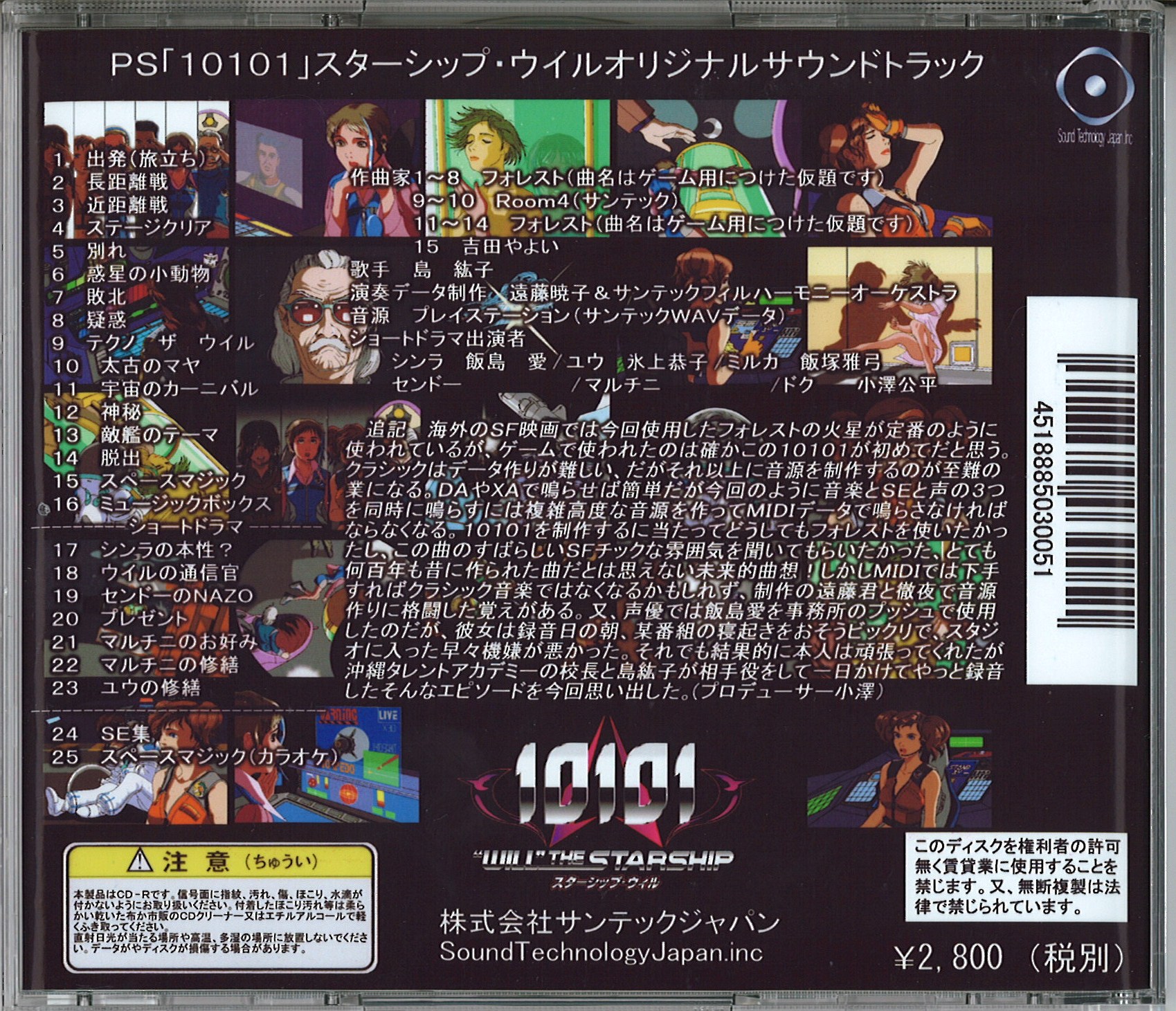
As discussed above, MobyGames lists Mitsui under Directed by, Planning and Scenario, not under Sound (MobyGames, n.d.-b). Sound is Endo Akiko, Noda Toshifumi, and Noguchi Kazumasa. The MobyGames credits are romanized; the soundtrack insert separately prints 遠藤暁子 for Endo Akiko (also credited separately for SEQ Programming), and Suntec's archived mail-order page (Sound Technology Japan, 2004) also wrote her name in kanji across three 2001 Suntec Records (Japanese Wikipedia, n.d.-c) CD-R listings (STCX0004, STCX0005, and STCX0006). The kanji for Noda and Noguchi, while they can reasonably be inferred, are not stated anywhere. Both Satomi no Nazo and 10101: "Will" The Starship (1997) credit their development staff exclusively in romaji in-game (even the Japanese Wikipedia entry of Satomi no Nazo (Japanese Wikipedia, n.d.-e) transcribes the staff roll into hiragana (えんどうあきこ, せきたかかず, よしだやよい, etc.)). On MobyGames, every other staff member who only ever appeared in Satomi no Nazo and/or 10101 also lacks kanji, whereas staff with kanji on MobyGames got theirs from credits on other companies' games. If you cross-reference the in-game sound credits of 10101 against the 2001 limited CD-R soundtrack (STCX0005) (Sound Technology Japan, 2004) and other releases, Noda and Noguchi disappear from the separate composition credits. The soundtrack CD-R credits the 13 BGM tracks to a group/alias name, フォレスト (Forest) and others (他). The others are ルーム4 (Room 4; specifically mentioned as "performer" (演奏) at STCX0001 and STCX0004, but not here) and Yoshida Yayoi (吉田やよい, or as the game package prints, 吉田 弥生; Sound Technology Japan, 1997c), who's credited for the ending theme SPACE MAGIC (Game Music Best 100 Wiki, 2025). On MINT The Original Soundtrack (みんと ~オリジナル サウンドトラック~, STCX0002), ルーム4 is identified in the English liner notes as an internal Sound Technology Japan team (Sound Tec Records, Sound Team ROOM 4; VGMdb, 1999), listing director Inoue Sara and operator Endo Akio.
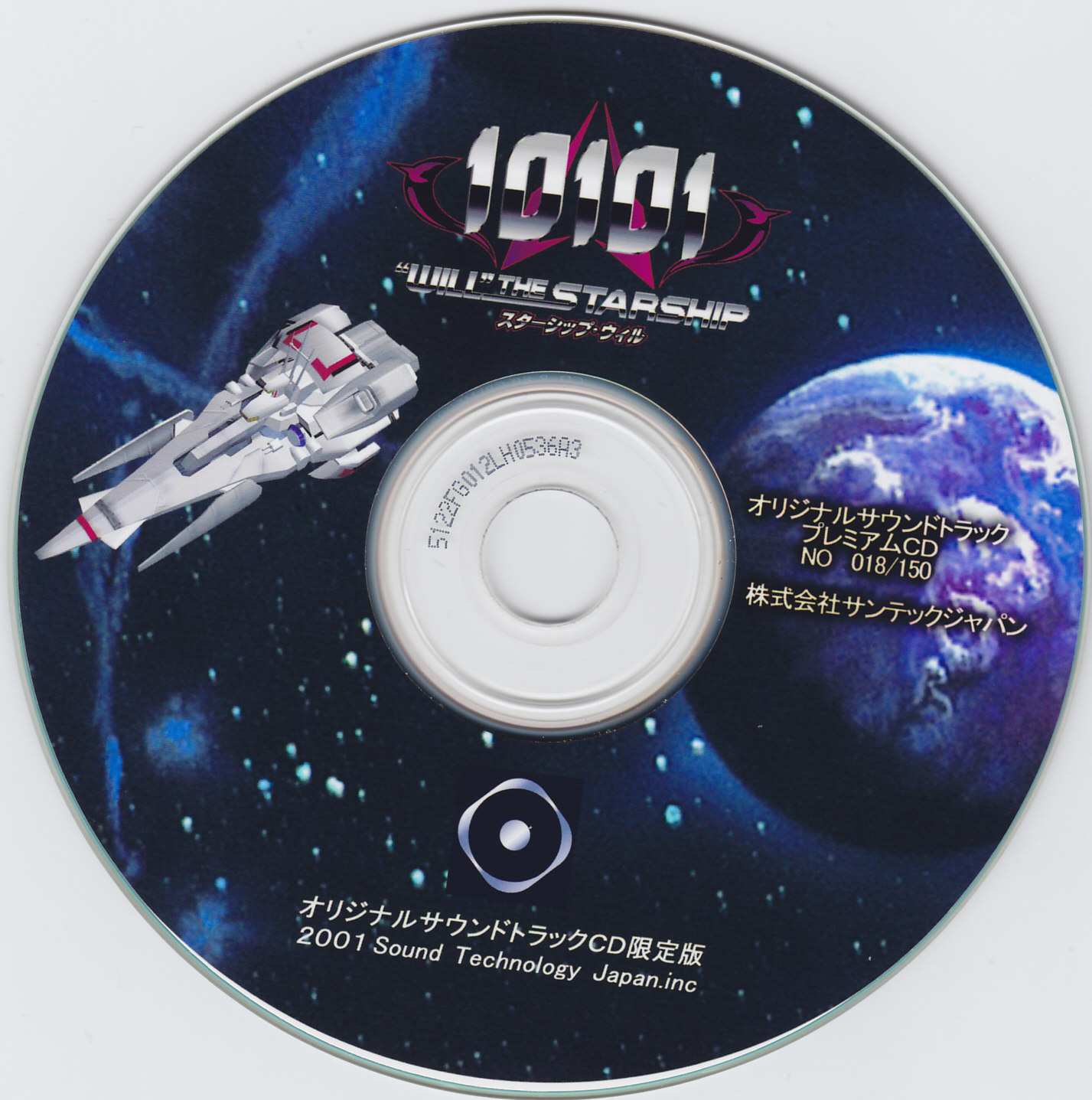
VGMdb lists the 2001 CD-R STCX0005 (barcode 4518885030051), published by SOUND TECHNOLOGY JAPAN, INC., limited to 150 copies (VGMdb, 2001). The scanned disc is dated 2001 and numbered 018/150; the insert identifies the publisher and CD-R format (Sound Technology Japan, n.d.). It credits Music Data Creation to Akiko Endo and the Sound Technology Philharmonic Orchestra. Some tracks are listed as arrangements of Holst’s Jupiter, Mars, Mercury and Venus. The album-wide Sound credits also name Endo, Noda and Noguchi, matching the game’s Sound credits, but their precise contribution isn't established (VGMdb, 2001).
What I did manage to establish is Iijima Ai's (飯島愛) role. The flyer advertises her with「ゲーム声優に初挑戦!!」(First Try at Voice Acting for a Video Game!!) (Sound Technology Japan, 1997a), which conflicts with her earlier credit in Magical Pop'n (1995) (MobyGames, n.d.-c). I have also managed to confirm the existence of the infamous オススメ (recommended) seal (about which we're going to talk more in subsequent articles). VGCollect's photograph of 10101 shows a pink オススメ label with Suntec Japan branding (VGCollect, n.d.). Gamers Eden says the manufacturer applied Satomi no Nazo's recommendation sticker, but supplies no source for that attribution (Gamers Eden, n.d.). While I did find the Satomi no Nazo stickers showcased in an Amazon listing, this one slightly differs from the verified 10101 one (Amazon.co.jp, n.d.-a), although the close-up does look convincing (Amazon.co.jp, n.d.-b). This doesn't clarify who conceived either label, whether all launch copies carried one, or the rumored Sony complaint and later removal.
Since we started with a schizo hypothesis that turned out to be untrue, let's end with another one. I had the idea that the bridge of "Will" might have been modelled on a karaoke room. This is not as far-fetched, if you think about it. Let's investigate.
The manual describes a bridge screen operated through role-specific crew icons. Pointing to one of six main crew members brings up the character's commands, with Doc's strategic hints and Martini's equipment management as examples. Its battle sequence is: select a command, set the aim, charge energy, fire (Sound Technology Japan, 1997b, printed pp. 2–4). A 2026 play blog describes Sendo’s (センドー) "Check" (チェック) as revealing the cause of a steering problem that results in frustrating Game Overs unrelated to actual combat with enemies (Retrogame Jaxx, 2026). ("クソゲー認定されても仕方ないなこれは。" - "I guess it’s no wonder this game gets labeled as crap," not quite a flattering critique.) MobyGames talks about combat as first-person aiming and firing, and the field map as top-down with the ship always moving forward and rotating (MobyGames, n.d.-a). Japanese Wikipedia says the ship can only go straight or turn, and spends energy constantly while moving (Japanese Wikipedia, n.d.-a). I do not see karaoke anywhere.
Why would a space battleship's bridge even resemble a karaoke room, just because the developer has some vague relation to the karaoke industry? That sounds like a stupid analogy, right? Well, yeah. That's exactly why I wanted it to be true.
The research behind this document was substantially aided by Lumen (OpenAI Dots), Grok Bot, and Gemini 4 Argon. Everything was independently verified by me, so if there are any remaining mistakes in the text, those are mine.
References
- Amazon.co.jp. (n.d.-a). 里見の謎 cover art [Photograph]. Amazon Japan product listing: サンテックジャパン 里見の謎 (PlayStation). https://m.media-amazon.com/images/I/81CuUN91O9L.AC_SL1500.jpg.
- Amazon.co.jp. (n.d.-b). "オススメ RPG 里見の謎・SLPS 00613" label [Photograph]. Amazon Japan product listing: サンテックジャパン 里見の謎 (PlayStation). https://m.media-amazon.com/images/I/71aD5BOt9NL.AC_SL1500.jpg.
- BMB. (2005, February 10). 沿革 (Corporate history) [Archived web page]. Wayback Machine.
- BMB International Corp. (2026). Company history table. BMB.
- Game Music Best 100 Wiki. (2025, February 1). 10101~"WILL" The Starship~. https://w.atwiki.jp/gamemusicbest100/pages/8895.html.
- Gamers Eden. (n.d.). 里見の謎 (Satomi no Nazo review & credits). Gamers Eden.
- Japanese Wikipedia. (n.d.-a). 10101〜“WILL”The_Starship〜. Retrieved October 13, 2026, from https://ja.wikipedia.org/wiki/10101〜“WILL”The Starship〜.
- Japanese Wikipedia. (n.d.-b). サンテックジャパン. Retrieved October 9, 2026, from https://ja.wikipedia.org/wiki/サンテックジャパン.
- Japanese Wikipedia. (n.d.-c). サンテックレコード. Retrieved October 14, 2026, from https://ja.wikipedia.org/wiki/サンテックレコード.
- Japanese Wikipedia. (n.d.-d). サンテックジャパン (Revision history). MediaWiki.
- Japanese Wikipedia. (n.d.-e). 里見の謎. Retrieved October 14, 2026, from https://ja.wikipedia.org/wiki/里見の謎.
- Japanese Wikipedia. (2010a, January 24). サンテックジャパン (Revision 30167684). MediaWiki.
- Japanese Wikipedia. (2010b, June 17). サンテックジャパン (Diff: Revision 32640835 vs 32640994). MediaWiki.
- Japanese Wikipedia. (2011, December 11). サンテックジャパン (Revision 40364532). MediaWiki.
- Japanese Wikipedia. (2023, July 19). サンテックジャパン (Revision 96070309). MediaWiki.
- Mitsui, K. (n.d.-a). サンテック [Company description]. Asahi-Net.
- Mitsui, K. (n.d.-b). 三井一正ホームページ [Homepage]. Wayback Machine.
- Mitsui, K. (n.d.-c). 三井一正プロフィール [Career profile]. Asahi-Net.
- MobyGames. (n.d.-a). 10101: “Will” The Starship. Game entry.
- MobyGames. (n.d.-b). 10101: “Will” The Starship, PlayStation full credits. Credits.
- MobyGames. (n.d.-c). Magical Pop'n credits (Super Famicom, 1995). MobyGames.
- MobyGames. (n.d.-d). Satomi no Nazo, PlayStation full credits. Credits.
- PlayStation.com Japan. (2008, December 13). SLPS-01054 software catalogue entry [Archived web page]. Wayback Machine.
- Redump. (n.d.). Disc 34804: 10101: "Will" the Starship (SLPS-01054). Redump.
- Retrogame Jaxx. (2026, July 5). 雑記:10101 WILL The STARSHIP. Gemanizm.
- Sound Technology Japan. (n.d.). 10101 “WILL” The Starship Sound Track, original package scans. Back insert and producer note; disc label.
- Sound Technology Japan. (1997a). 10101 launch advertisement. Front; back with Iijima slogan.
- Sound Technology Japan. (1997b). 10101 “WILL” The Starship manual. Original scan; Archive item.
- Sound Technology Japan. (1997c). 10101 package back. Original scan.
- Sound Technology Japan. (1999, November 15). Sound production rate card [Archived web page]. Wayback Machine.
- Sound Technology Japan. (2000, December 10). Sound production rate card [Archived web page]. Wayback Machine.
- Sound Technology Japan. (2001, December 20). Package rate card [Archived web page]. Wayback Machine.
- Sound Technology Japan. (2004, August 17). Mail-order page [Archived web page]. Wayback Machine.
- VGCollect. (n.d.). 10101 “WILL” The Starship, item 181081. Entry; front photograph.
- VGMdb. (1999). MINT The Original Soundtrack (STCX-00002) [Album entry]. https://vgmdb.net/album/20127.
- VGMdb. (2001). 10101 "WILL" The Starship Sound Track (STCX-0005) [Album entry]. https://vgmdb.net/album/14766.