Suntec Japan: The Personnel Network
Tracing the people credited on Sound Technology Japan's (Suntec) PlayStation games and the wider circle around them.
The network on the record
Over the past three posts, we've traced Sound Technology Japan through its games, music production, and corporate history. Now, it's time to take a closer look at the individuals behind the studio. The games' (Satomi no Nazo (里見の謎, 1996) and 10101 "WILL" The Starship (1997)) credits suggest a small production team with recurring names, and a wider circle of collaborators. I couldn't find an employee register, though, so this shouldn't be treated as such. While contribution is confirmed by a programming credit, it doesn't tell us whether the person credited was full-time staff, an external contractor, or simply an acquaintance brought in during final crunch. (Sound Technology Japan, 1996a, 1996b, 1997b).
Regarding the sources, our vade mecum is going to be the Satomi manual's staff page (Internet Archive scan is available). Its staff names are romanized, as are the two games' ending credits. The available 10101 manual scan has no staff-credit page at all, unfortunately. We'll use any material we have. (Sound Technology Japan, 1996b, 1997c).
The credited group
This is a working roster of the principal production and performance credits. Not claiming completion, but it's close enough. The two game columns come from the original credits and, for Satomi, the printed manual. (Sound Technology Japan, 1996a, 1996b, 1997b).
| Credited name | Satomi no Nazo (1996) | 10101 (1997) |
|---|---|---|
| Mitsui Kazumasa | Scenario; director | Planning; scenario; director |
| Yokotsuka Eiichirou | Program | Planning; scenario; programming |
| Yamaki Norihito | Program | Programming |
| Ozawa Yumeo | Story concept; producer | Story concept; planning; producer |
| Ozawa Kouhei | Thanks | Scenario; voice |
| Ozawa Mayumi | Management | Management |
| Endo Akiko | Sounds | Sound; sequencer programming |
| Noda Toshifumi | - | Sound |
| Noguchi Kazumasa | - | Sound |
| Chiba Hirotaka | Assistant director | Planning; assistant director |
| Seki Takakazu | Character design | Character design and directions |
| Suzuki Tomomi | Graphics | Graphics |
| Takahashi Hideo | Map design | - |
| Kondo Hisayo | Graphics | - |
| Yoshida Yayoi | Music for three named pieces | Music for "Space Magic" |
| Mama Hanako | Lyrics for "Ryusei no Tiara" | Lyrics for "Space Magic" |
| Suzuki Kazumi | Lyrics for "Toki o Koeta Koibitotachi" | - |
| Shima Hiroko | Vocal and voice | Voice; "Space Magic" vocal |
| Uematsu Noboru | Jacket and booklet | - |
| Koma Hiroko | Jacket and booklet, in the manual | - |
| Ota/Ohta Hirokazu | Supervisor | - |
| Wada Kouji | - | Character stylist |
| Nakazawa Naoto | - | Mechanical design; graphics |
| Nishiyama Makoto | - | Painting |
| Maemura Yoko | - | Painting |
| Wakao Katsuhiko | - | Jacket design |
| Iijima Ai | - | Voice |
| Hikami Kyoko | - | Voice |
| Iizuka Mayumi | - | Voice |
| Okawa Toru | - | Voice |
| Ishida Akira | - | Voice |
Two small differences I want to mention. The Satomi manual includes HIROKO KOMA in its jacket-and-booklet block, but the ending screenshots don't. The additional vocal/voice name is LOVELY in the manual and LOVERY in the ending. 10101 thanks LOVELY. (Sound Technology Japan, 1996a, 1996b, 1997b).
Some firms are also mentioned, for example, Satomi credits VIVA MAMBO, Inc. alongside its own personnel; 10101 credits MOST MUSIC INC. for 3D graphics. (Sound Technology Japan, 1996b, 1997b).
Mitsui Kazumasa
Mitsui provides the clearest account of his own route into Suntec. His personal page lists an artist contract with Pony Canyon (株式会社ポニーキャニオン) in 1985–87, which produced two albums and five singles. He then worked under contract for Ariga Associates between 1988 and 1990 composing game music for Koei, followed by a directorial contract with Suntec Japan from 1993 to 1997, before shifting to freelance game and music production from 1998. (Mitsui, n.d.-c).
His artist page mentions the music unit FANTI, names Ariga Tsuneo (有賀恒夫) as its producer, and lists the albums THEATRE CITY and ROUGH MIX. His Koei page lists Suikoden: Tenmei no Chikai (水滸伝 ~天命の誓い~) and Leading Company / Key of City. For the latter, VGMdb's Keys of the city album entry assigns track 5, "Floater," to Mitsui and dates the album to October 25, 1990. (Mitsui, n.d.-d, n.d.-e; VGMdb, n.d.-b).
JOYSOUND credits 三井一正(FANTI) as the composer of Okada Yukiko's (岡田有希子) "Ginga no Vacance" (銀河のバカンス). Mitsui's own artist page also names Hori Chiemi (堀ちえみ) among artists whose albums he participated in, doing programming, composition, and chorus work together. (JOYSOUND, n.d.; Mitsui, n.d.-d).
On the two Suntec games, the name Mitsui appears in direction and scenario. Besides these, planning was added on 10101. His company-description page likewise puts game direction and scriptwriting next to Suntec's karaoke-data business. (Sound Technology Japan, 1996a, 1997b; Mitsui, n.d.-a).
After the contract period, the Hz company profile provides more information: HERZ (有限会社ヘルツ, where 有限会社 means "limited company (company structure for small businesses; abolished in 2006)," according to Jisho; just mentioning because I learned about this here), established in September 2001, with its representative listed as 高木(三井)一正 and a second director as 高木紀久子. The notation connects Takagi and Mitsui under the same given name, though it doesn't explain the legal circumstances of the surname usage. There's also no support for the different name 高木信, "Shin Takagi." (Hz Inc., n.d.).
I managed to find some evidence of later Suntec-related work too. VGMdb's entry for Kanda Michiko's (神田美智子) Okurete kita tenshi (遅れてきた天使, STCX-00003) credits Mitsui with direction, Yumeo Ozawa as executive producer and mixer, and Mayumi Ozawa with management. Suntec's mail-order page links the album to Sayonara no Hohoemi 2, which suggests a later collaboration (not an uninterrupted employment history). (VGMdb, n.d.-c; Sound Technology Japan, 2004g).
Yokotsuka and Yamaki
Yokotsuka's Suntec work is straightforward: a shared Program credit on Satomi, followed by Planning, Scenario and Programming on 10101. The spelling 横塚英一郎 appears in catalog records, but it can't be verified in the romanized Satomi manual. (Sound Technology Japan, 1996b, 1997b; MobyGames, n.d.-c).
Before those games, according to credit transcriptions, Game Design on Araiguma Rascal (あらいぐまラスカル) (1994) was his job, together with Shimizu Toru (清水徹), and Planning on Nekketsu Tairiku: Burning Heroes (熱血大陸バーニングヒーローズ) (1995). (SuperFamicom.org, n.d.; MobyGames, n.d.-c, n.d.-e; GDRI, 2016).
The Game Developer Research Institute (GDRI) transcription of the Game Boy Nangoku Shōnen Papuwa-kun: Ganmadan no Yabō (南国少年パプワくん ガンマ団の野望) (1994) includes よこつか えいいちろう in Special Thanks and やまき のりひと as Sub Programmer. (Doommaster1994, n.d.).
Dragon Force (ドラゴンフォース) (1996) lists four other planners and no Yokotsuka, which supports "not listed in these credits." The transcription cannot establish that he never worked on an earlier version, so the account of a 1996 move to Suntec stays plausible, but it's not a date I recovered from the rolls. (raido, n.d.; Japanese Wikipedia, n.d.-f).
I'd be cautious about the claim that Yokotsuka devised Satomi's "recommended RPG" sticker and automatic naming system as well. The Japanese Wikipedia article attributes those ideas to him, but I couldn't find a development statement or a production record that'd support this. (Japanese Wikipedia, n.d.-f).
Another name we should look into is Iara Rase (イアラ・ラセ). 2DFan assigns Sayonara no Hohoemi and Mint to Iara Rase with Kagami Nagisa (鏡なぎさ), and Sayonara no Hohoemi 2 to Iara Rase. Wikipedia links the name to Yokotsuka, but there's no evidence, as usual. (2DFan, n.d.; Japanese Wikipedia, n.d.-f).
The credits of 10101 include NORIHITO YAMAKI. Beyond Suntec, MobyGames adds a PoPoLoCrois (ポポロクロイス物語) programming credit to his work, while the original Tomica Town o Tsukurō! (トミカタウンを作ろう!) credits identify 山木典人(DML) as chief programmer (attestation of the kanji and a later, 1999 credit). (Sound Technology Japan, 1996a, 1997b; MobyGames, n.d.-f; Tomy, 1999).
The sound credits
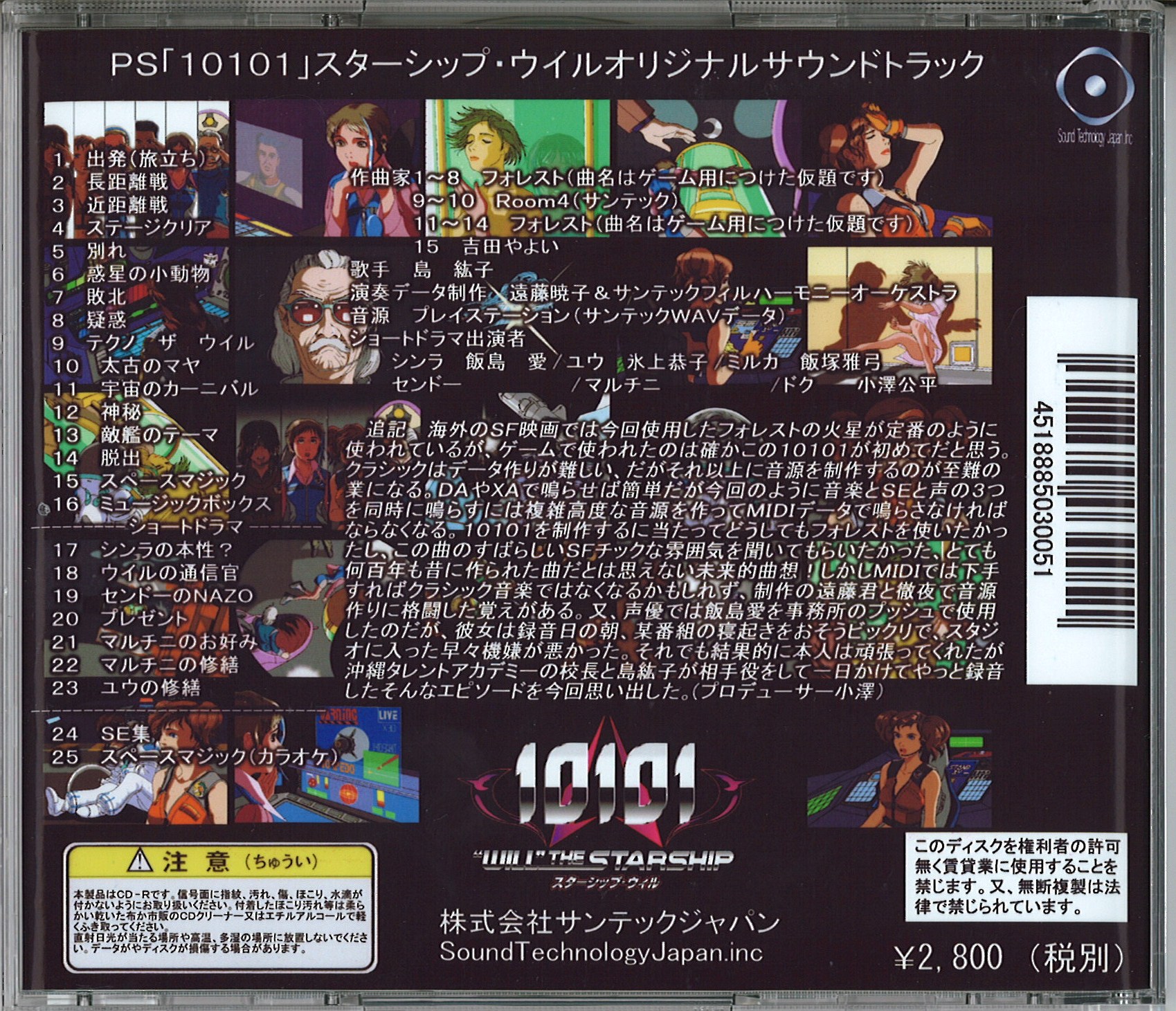
Under Satomi's Sounds heading, the only name is Endo Akiko. 10101 adds Noda Toshifumi and Noguchi Kazumasa under Sound, while giving Endo the separate SEQ Programming credit. Her kanji are documented well enough. The 10101 soundtrack insert mentions 遠藤暁子, and Suntec's mail-order page uses the same spelling for both Satomi and 10101. (Sound Technology Japan, n.d., 1996b, 1997b, 2004g).
Noguchi is a little more complicated. VGMdb lists Kazumasa Noguchi as an alias of Mitsui. The fact that 10101 credits Mitsui in direction and Noguchi in sound doesn't disprove that listing, I mean, I also have multiple Discord accounts. Therefore, the responsible verdict is... unresolved. No Japanese spelling is assigned to Noda or Noguchi here without a source tying it to these particular credits. (VGMdb, n.d.-a; Sound Technology Japan, 1997b).
10101 explicitly credits sequenced sound featuring Gustav Holst's The Planets. Its soundtrack insert lists Room4 (ルーム4) for two compositions and Yoshida Yayoi for "Space Magic." (Sound Technology Japan, n.d., 1997b).
Yoshida is credited with three named pieces in the Satomi manual too. 10101's back cover supplies 吉田弥生. MobyGames files the two games' Yoshida credits under Yayoi Kurebayashi. Suntec's own later mail-order page does name 紅林やよい for Sayonara no Hohoemi, so Kurebayashi is more than a Wikipedia fabrication, but there's no primary source explicitly connecting Kurebayashi and Yoshida. (Sound Technology Japan, 1996b, 1997a; MobyGames, n.d.-a, n.d.-g; Sound Technology Japan, 2004g).
The Ozawas
Yumeo Ozawa (小澤夢生) is credited with story concept and production on both games, and with planning on 10101. Those roles are directly visible. (Sound Technology Japan, 1996a, 1997b).
Kouhei Ozawa appears in Satomi's thanks and in 10101's Scenario and Voice sections. The soundtrack insert also identifies 小澤公平 as Doc in its short-drama cast, so the character association is not solely a Wikipedia claim. (Sound Technology Japan, n.d., 1996a, 1997b).
Mayumi Ozawa is credited with management on both games, and the later Kanda album catalog entry also lists her. (Sound Technology Japan, 1996a, 1997b; VGMdb, n.d.-c).
Shima Hiroko and the Okinawa connection
Shima's performance work is among the better documented parts of this network. She appears under Vocal & Voice in Satomi, and under Voice and the "Space Magic" vocal in 10101. The latter's packaging prints her name as 島紘子. (Sound Technology Japan, 1996b, 1997a, 1997b).
A Scramble Egg retrospective lists Shima as the Okinawa/RBC representative and Grand Prix winner at the nineteenth Nagasaki Kayōsai in 1995. The publication says it covered that year's competition. This supports the win, though the article does not supply every detail later attached to it, such as her exact age or chosen song. (KEN, 2002).
Scramble Egg's 1999 SYRUP feature names her as HIROKO in the four-member group and identifies all four as Okinawa Talent Academy students. It reports that the group won the top prize at an OTV-hosted Pony Canyon audition in September 1998. (Okada, 1999).
The same feature announces an Okinawa-only release of "FLOWERS" on Pony Canyon's DNA CAPSULES label in late April 1999. Its body gives April 29, while the issue-contents wording gives April 28. The disagreement is present in the publication itself, so "late April" is preferable until a record-company or disc source settles the exact day. (Okada, 1999).
Suntec later advertised an untitled Shima album as STCX0006, with a December release planned and songs credited to Kurebayashi, Sawamura and Endo. The archived page does not specify the year of that December, and it contains no cancellation notice. (Sound Technology Japan, 2004g).
J-Force
J-Force (株式会社ジェイフォース) provides a potential route by which experienced game developers entered Suntec's orbit. Yokotsuka's credits on its productions, and the earlier Papuwa-kun connection shared with Yamaki, are concrete. The familiar story of the company's collapse is less securely documented. (SuperFamicom.org, n.d.; MobyGames, n.d.-e; Doommaster1994, n.d.; GDRI, 2016).
GDRI recounts that J-Force was started by former Wolf Team head Akishino Masahiro (秋篠雅弘), ran into development trouble, and collapsed during Dragon Force, after which Sega finished the game and much of its original staff joined Idea Factory (アイディアファクトリー株式会社). But GDRI's footnote for this account points to Japanese Wikipedia, those two pages therefore cannot be treated as independent confirmation of the narrative. MobyGames' Dragon Force history provides another retelling, including a 1995 date. (GDRI, 2016; MobyGames, n.d.-b).
It's not accurate to say that every Japanese retelling is completely uncited: the current J-Force article includes a reference to a 2017 print mook for part of its account. That book was not inspected for this article (I'm broke). (Japanese Wikipedia, n.d.-j).
Idea Factory's own history establishes an October 27, 1994 founding date and describes its founders' careers, but it doesn't mention the claimed transfer of most of J-Force's staff. (Idea Factory, n.d.).
The Academy
The Okinawa Talent Academy (沖縄タレントアカデミー) relationship is quite substantial. Its archived introduction dates its foundation to June 1984. Ozawa Kouhei's archived school biography names him as principal of both the academy and Multimedia Gakuin (マルチメディア学院), and as RAP's (株式会社ラップ) representative. It dates RAP's establishment to June 1993 and Multimedia Gakuin's to 1995. (Okinawa Talent Academy, 2003a, 2003b).
Both games thank the academy and Multimedia Gakuin. The game's back cover explicitly gives the academy a 制作協力, or production-cooperation, credit. The soundtrack's note, signed "Producer Ozawa," recalls the academy principal and Shima helping as opposite performers during Iijima's voice recording. (Sound Technology Japan, n.d., 1996b, 1997a, 1997b).
The proposed family connection also has better evidence than a chain of Wikipedia pages. In a December 2012 post, Kouhei Ozawa describes a poem written for his younger brother Yumeo. His blog's introductory biography describes the same academy and RAP career as the archived school site. This is primary family testimony. (Ozawa, 2012a, 2012b; Okinawa Talent Academy, 2003b).
A SYRUP fan page, in an entry labelled September 9, 2002, explicitly calls Suntec's Yumeo the academy principal's younger brother. It uses hearsay wording. The date displayed on a live fan page is not proof that the wording has remained unchanged since 2002, so it should not be used to reconstruct the claim's first appearance without archival evidence. It does, however, show why the company-specific connection remains a distinct sourcing question from Kouhei's own statement that he has a brother named Yumeo. (miraclejiro, 2002).
The "cheap student labour" story goes much further. Production cooperation and a student singer's participation don't establish that academy students supplied the programming or graphics, much less what they were paid. That would require identified participants, a training or placement record, a production account, or payment evidence.
The academy's performance chronology and RAP's published business scope don't close that gap in the opposite direction. The retrieved chronology concerns stage and broadcast work and identifies its information as current to February 2003; it is not an exhaustive register of every person's outside work. RAP's page lists talent training, events, audiovisual production and related services. Neither page establishes a programming placement, but neither proves that one never occurred. (Okinawa Talent Academy, 2009; RAP, 2004).
The cast and Iijima's "debut"
The 10101 roll names Iijima Ai (飯島愛), Hikami Kyoko (氷上恭子), Iizuka Mayumi (飯塚雅弓), Shima Hiroko (島紘子), Okawa Toru (大川透), Ishida Akira (石田彰) and Kouhei Ozawa. Mausu's (株式会社マウスプロモーション) own pages date Okawa's and Hikami's entry to 1994. That supports part of the proposed agency cluster. (Sound Technology Japan, 1997b; Mausu Promotion, n.d.-a, n.d.-b, n.d.-c).
The soundtrack note offers a more specific account: Producer Ozawa says Iijima was used at her agency's urging. (Sound Technology Japan, n.d.).
The advertising claim is much easier to check. Both the available promotional leaflet and the game's back cover describe Iijima as making her first attempt at game voice acting: ゲーム声優に初挑戦. Yet Magical Pop'n (マジカルポップン), released in 1995, already credits Ai Iijima with Character Voice. Taken literally, the 1997 claim is contradicted by that earlier credit. (Sound Technology Japan, 1997a, 1997d; MobyGames, n.d.-d).
Looking through the list of names (recurring programmers and artists, a musician directing the games, producers with recording and performance connections, and an academy that demonstrably helped with production), the credits form a recognizable cluster.
I wish I had friends, too. However, I do have AI subscriptions. Throughout my journey of connecting the dots, I've received substantial assistance from GPT-6 Astra. Everything was independently verified by me, so if there are any remaining mistakes in the text, those are mine.
References
- 2DFan. (n.d.). イアラ・ラセ [Creator tag and game-credit listings]. https://2dfan.com/tags/イアラ-ラセ
- Doommaster1994. (n.d.). Credits 02: Nangoku Shounen Papuwa-kun: Ganmadan no Yabou [Credit transcription]. Game Developer Research Institute. https://gdri.smspower.org/wiki/index.php/User:Doommaster1994/Credits_02
- GDRI. (2016, November 16). J-Force. Game Developer Research Institute. https://gdri.smspower.org/wiki/index.php?title=J-Force&oldid=19008
- Hz Inc. (n.d.). 有限会社ヘルツ [Company profile]. http://www.hz-inc.co.jp/Pages/about_Hz.html
- Idea Factory. (n.d.). 会社概要・沿革. https://www.ideaf.co.jp/company/
- Japanese Wikipedia. (n.d.-f). 里見の謎. Retrieved October 20, 2026, from https://ja.wikipedia.org/wiki/里見の謎
- Japanese Wikipedia. (n.d.-j). Jフォース. Retrieved October 20, 2026, from https://ja.wikipedia.org/wiki/Jフォース
- JOYSOUND. (n.d.). 銀河のバカンス/岡田有希子 [Song 213928]. https://www.joysound.com/web/search/song/213928
- KEN. (2002, August 20). 芸能予備軍事情10~長崎歌謡祭を振り返って. Scramble Egg. https://www.scramble-egg.com/column/42k10a.htm
- Mausu Promotion. (n.d.-a). 会社概要・沿革. https://mausu.net/about/
- Mausu Promotion. (n.d.-b). 大川透 [Talent profile]. https://mausu.net/talent/okawa-toru.html
- Mausu Promotion. (n.d.-c). 氷上恭子 [Talent profile]. https://mausu.net/talent/hikami-kyoko.html
- miraclejiro. (2002, September 9). SYRUP fan-page log018 [Entry date as displayed]. http://miraclejiro.web.fc2.com/log018.htm
- Mitsui, K. (n.d.-a). [Company description]. http://www.asahi-net.or.jp/~JR7K-MTI/Pages/stj.html
- Mitsui, K. (n.d.-c). 三井一正プロフィール. http://www.asahi-net.or.jp/~JR7K-MTI/Pages/plofile.html
- Mitsui, K. (n.d.-d). アーティスト契約 [FANTI and album participation]. https://www.asahi-net.or.jp/~JR7K-MTI/Pages/artist.html
- Mitsui, K. (n.d.-e). 光栄ゲームミュージック [Work list]. https://www.asahi-net.or.jp/~JR7K-MTI/Pages/koei.html
- MobyGames. (n.d.-a). 10101: "Will" the Starship [PlayStation credits, game 252287]. Retrieved October 20, 2026, from https://www.mobygames.com/game/252287/10101-will-the-starship/credits/playstation/
- MobyGames. (n.d.-b). Dragon Force [Game 10816, development history]. Retrieved October 20, 2026, from https://www.mobygames.com/game/10816/dragon-force/
- MobyGames. (n.d.-c). Eiichirō Yokotsuka [Person 472125]. Retrieved October 20, 2026, from https://www.mobygames.com/person/472125/eiichiro-yokotsuka/
- MobyGames. (n.d.-d). Magical Pop'n [SNES credits, 1995]. Retrieved October 20, 2026, from https://www.mobygames.com/game/21395/magical-popn/credits/snes/
- MobyGames. (n.d.-e). Nekketsu Tairiku: Burning Heroes [Game 14058]. Retrieved October 20, 2026, from https://www.mobygames.com/game/14058/nekketsu-tairiku-burning-heroes/
- MobyGames. (n.d.-f). Norihito Yamaki [Person 1386209]. Retrieved October 20, 2026, from https://www.mobygames.com/person/1386209/norihito-yamaki/
- MobyGames. (n.d.-g). Satomi no Nazo [PlayStation credits, game 251172]. Retrieved October 20, 2026, from https://www.mobygames.com/game/251172/satomi-no-nazo/
- Okada. (1999, May 9). SYRUP [Scramble Egg no. 10 feature]. https://www.scramble-egg.com/artist/syrup.htm
- Okinawa Talent Academy. (2003a, October 22). 沖縄タレントアカデミーの紹介 [Wayback capture]. https://web.archive.org/web/20031022165236id_/http://www.geocities.jp/talent_ajp/academy/academy-shoukai.html
- Okinawa Talent Academy. (2003b, October 23). 主宰者の挨拶・小澤公平略歴 [Wayback capture]. https://web.archive.org/web/20031023071551id_/http://www.geocities.jp/talent_ajp/academy/aisatu.html
- Okinawa Talent Academy. (2009, June 20). 作品と上演略歴 [Wayback capture]. https://web.archive.org/web/20090620004201id_/http://www.geocities.jp/talent_ajp/academy/shoenn.html
- Ozawa, K. (2012a, November 27). ぐすーよー今日うがなびら. https://ozawakouhei.wordpress.com/2012/11/27/hello-world/
- Ozawa, K. (2012b, December 11). 子供に優しかった母. https://ozawakouhei.wordpress.com/2012/12/11/子供に優しかった母/
- raido. (n.d.). Dragon Force [Saturn staff-credit transcription]. https://raido.moe/staff/sat/sat_dragon_force_1.html
- RAP. (2004, February 27). (株)RAP 業務内容 [Wayback capture]. https://web.archive.org/web/20040227112134id_/http://www.geocities.jp/talent_ajp/rap/gyoumu.html
- Sound Technology Japan. (n.d.). PS「10101」スターシップ・ウィル オリジナルサウンドトラック [Insert, credits and producer's note]. https://media.vgm.io/albums/66/14766/14766-1248838704.jpg
- Sound Technology Japan. (1996a). 里見の謎 [Ending credits, original screenshots]. https://raido.moe/staff/ps1/source/ps1_satomi_no_nazo.rar
- Sound Technology Japan. (1996b). 里見の謎 [Instruction manual, staff list p. 29; PDF p. 16]. https://archive.org/download/satomi-no-nazo-scans/Satomi%20no%20nazo%20scans.pdf
- Sound Technology Japan. (1997a). 10101 "WILL" The Starship [Back cover, SLPS-01054]. https://archive.org/download/10101willthestarshipmanualscanjpplaystationpsx/Back.jpg
- Sound Technology Japan. (1997b). 10101 "WILL" The Starship [Ending credits, original screenshots]. https://raido.moe/staff/ps1/source/ps1_10101_will_the_starship.rar
- Sound Technology Japan. (1997c). 10101 "WILL" The Starship [Instruction manual]. https://archive.org/download/10101willthestarshipmanualscanjpplaystationpsx/10101%20Will%20the%20Starship%20%28Manual%29%28Scan%29%28JP%29%28PlayStation%29%28PSX%29.pdf
- Sound Technology Japan. (1997d). 10101 "WILL" The Starship [Promotional leaflet, reverse]. https://archive.org/download/10101willthestarshipmanualscanjpplaystationpsx/Advert%20Back.jpg
- Sound Technology Japan. (2004g, August 18). stjp.com オンライン [Mail-order page; Wayback capture]. https://web.archive.org/web/20040818013743id_/http://www.stjp.com/pages/online.htm
- SuperFamicom.org. (n.d.). Araiguma Rascal / Raccoon Rascal [Game record and staff transcription]. https://superfamicom.org/info/araiguma-rascal-raccoon-rascal
- Tomy. (1999). トミカタウンをつくろう! [Ending credits, original screenshots]. https://raido.moe/staff/ps1/source/ps1_tomicatown_o_tsukuro.rar
- VGMdb. (n.d.-a). Kazumasa Mitsui [Artist 881]. Retrieved October 20, 2026, from https://vgmdb.net/artist/881
- VGMdb. (n.d.-b). Keys of the city (KECH-1006) [Album 907]. Retrieved October 20, 2026, from https://vgmdb.net/album/907
- VGMdb. (n.d.-c). 神田美智子 ~遅れてきた天使~ (STCX-00003) [Album 20129]. Retrieved October 20, 2026, from https://vgmdb.net/album/20129